Transport
Do you need a car in Marrakech? The answer depends on where you sleep
If you are sleeping in the medina, no. If you are sleeping outside the walls, yes, and it is not negotiable. Real prices, deposit, insurance, and the four habits that avoid 90% of disputes.
Updated 24 August 2026 5 min read By Les Dars de Marrakech
If you are sleeping in the medina, do not rent a car. You will not get down most of the lanes, parking is paid for and watched over, and everything you want to see is walkable. If you are sleeping outside the walls, rent one. Without a car every outing turns into a fare, and across a week that adds up to more than the rental itself.
What it really costs
Prices collected in August 2026 from rental firms operating in Marrakech. These are orders of magnitude, not contract rates: no international rental firm publishes a seasonal price list.
A comparison over the same week in September 2026 came out at 162 euros with Budget, 190 with Avis, 238 with Alamo and 379 euros with Europcar. More than double the spread for the same vehicle on the same dates. Compare prices, every time.
Fuel, as of 17 August 2026: petrol at 14.90 dirhams a litre, diesel at 14.87, roughly 1.38 euros. Prices are unregulated and revised twice a month, on the 1st and the 16th. Trust no published figure that comes without its date.
The four traps that keep coming back
The touts outside the terminal. They introduce themselves as agents for a rental firm, cut the price out loud, and the contract you end up signing covers a worn out vehicle with insurance that covers nothing. Go to the official desk, the one with a sign above it.
The scratches discovered on return. They were not recorded at pickup, and without proof you have no recourse. Film the vehicle all the way round at pickup and at return, paying attention to the sills, the wheels, the windscreen and the roof. Thirty seconds of video beats a ticked box.
The deposit. Expect 1,000 to 2,000 euros, held on a credit card in the driver’s name. Debit cards are very often refused, and the cash deposit some small firms offer is the one case where a dispute becomes impossible to settle. Check the release time they quote, and know that it is often overrun.
Airport fees. Between 200 and 400 dirhams added at the desk, plus an out of hours pickup surcharge, set at 396 dirhams including tax in one major brand’s price list. An additional driver is charged up to 667 dirhams.
Plenty of Marrakech rental firms deliver to your address for free. Asking for delivery on site removes the airport surcharge and saves you from driving through the city on arrival day, straight off a flight, with no bearings. It is the tip that buys the most comfort for nothing.
Insurance, and the word that misleads
Two things to hold on to; the priced detail is in the cost of a week with a car.
"Zero Excess" does not cover everything. Tyres, windows, windscreen, sills, roof and mirrors stay on you, and driving on an unsurfaced track voids most contracts outside a 4x4.
The second one is the expensive one: without a police report, the excess waiver often does not apply at all. Settle a bump amicably at the roadside and you pay for it yourself. Call the police, even for a dented wing.
The paperwork
Your national licence is enough for a tourist stay. An international permit is only required if your licence is not written in Latin characters. Some desks "recommend" one: that is convenience, not a legal obligation.
Minimum age: 21 in most cases, 23 to 25 for the higher categories and for 4x4s, with a young driver surcharge under 25. One year of licence minimum, two for the bigger engines.
To keep in the car at all times: licence, passport, rental contract, original vehicle registration document and insurance certificate. The agency hands you a folder. Never leave it at the house.
Driving, for real
Limits are 60 kilometres per hour in built up areas, sometimes 40, 100 on open road and 120 on motorway. Take 20 off in the rain. Fines are settled on the spot, in cash: insist on an official receipt, no receipt means it is not a fine.
Gendarmerie checkpoints are frequent on intercity roads, visible and straightforward. Recent speed cameras work in both directions and also pick up seatbelts, phones and crossing the solid line.
On alcohol, sources disagree between a 0.20 gram limit and zero tolerance. The rule to remember is simple: not one glass.
The most important advice in this article
Do not drive at night. The French foreign ministry advises firmly against it in Morocco, and with reason: secondary roads are unlit, animal drawn carts carry no lights, cyclists and pedestrians have no reflectors, and livestock roams free. Animal activity peaks between 18:00 and 20:00 in winter, between 20:00 and 22:00 in summer.
In practice: plan the return leg of any day trip to arrive before dark. A day at Ouzoud or Aït Ben Haddou is built around that constraint, not around the urge to stay an hour longer.
Parking in Marrakech
The council rate for street attendants is 2 dirhams by day, 4 at night, posted on more than 100 signs. What you will be asked for is higher. Hand over 5 to 10 dirhams for half a day and the matter is closed; without the rate in mind, the ask climbs to 50.
Supervised car parks sit along the ramparts, at Bab Doukkala, Bab Agnaou and around Jemaa el-Fna.
The alternatives, if you are not driving
- Uber has worked in Marrakech since November 2025, with drivers who already hold a licence.
- Heetch and Roby call official taxis.
- InDrive is widely used and very handy, but it is not legally authorised in Morocco. We mention it because our guests use it, not because we recommend it.
- Petit taxi: 7 dirhams to start, 5 to 6.5 dirhams a kilometre, minimum fare 15 to 20, a 50% night surcharge, three passengers maximum. The meter is a legal requirement. Insist it is switched on as you get in, or agree the price before setting off.
- Private driver by the day: 800 to 1,500 dirhams all in. For two people that costs more than a rental. From four people up it becomes competitive, and it removes the deposit, the parking and the argument at handback.
Where we stand
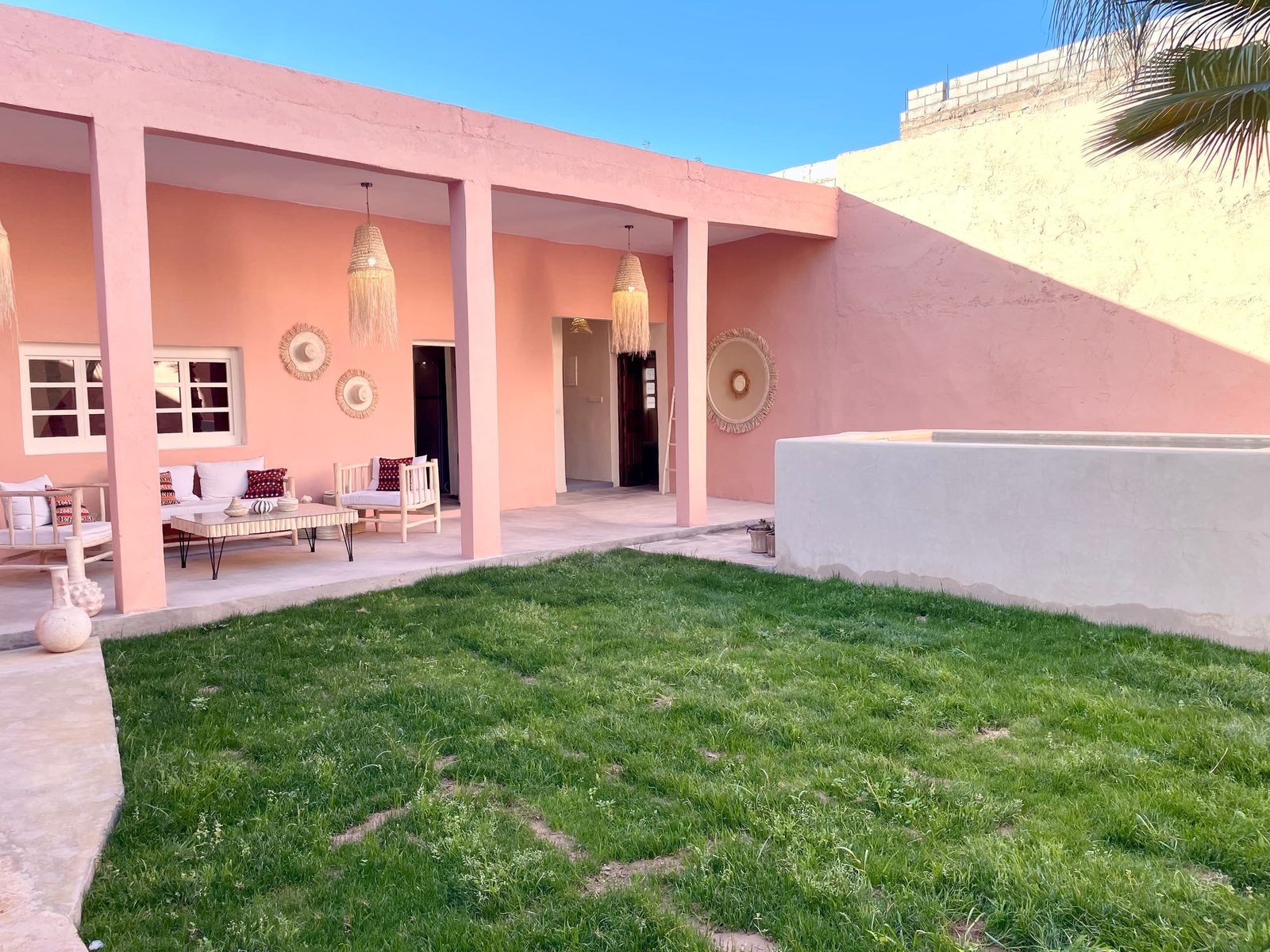
Out here, ten kilometres from the centre, one guest summed it up in three words in her review: vehicle absolutely essential. We are not going to argue. A free carport waits for you in front of the door, and another guest wrote, drily: I parked the car in front of the door. That is exactly it.